
AI Agents in 2026 is moving beyond simply answering questions.
In 2026, the conversation around AI is increasingly shifting from “What can AI tell me?” to “What can AI do for me?”
That change is being driven by AI agents.
Instead of only generating an answer when you ask a question, an AI agent can be designed to understand a goal, make decisions, use tools, complete multiple steps, and sometimes take actions on your behalf.
That sounds exciting and it is.
But there is another question that deserves just as much attention:
If AI starts doing more of our thinking and decision-making, what happens to the human mind when we begin depending on it too much?
The answer is more complicated than “AI is good” or “AI is bad.”
Recent research suggests that the way we use AI may matter more than simply how often we use it. Using AI as a tool that supports your thinking is different from allowing it to replace your thinking.
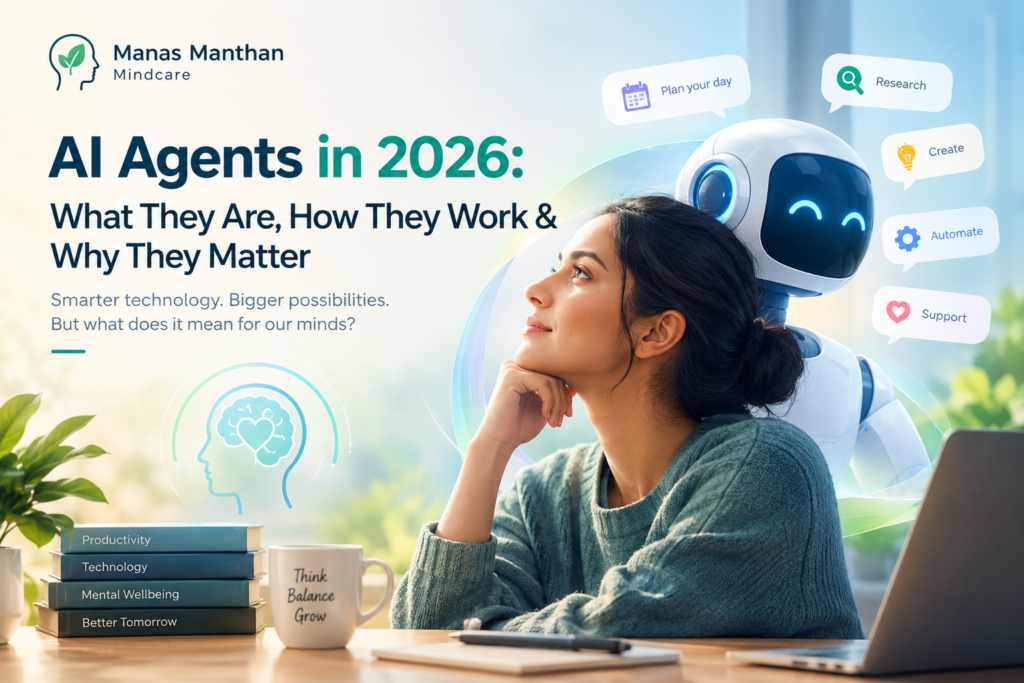
What Are AI Agents?
An AI agent is an AI-powered system designed to work toward a goal rather than simply respond to a single prompt.
A traditional chatbot might work like this:
You ask → AI answers → Conversation ends
An AI agent can work more like this:
You give a goal → AI plans → AI uses tools → AI performs tasks → AI evaluates progress → AI completes the goal
For example, instead of asking an AI:
“How do I book a flight?”
An AI agent could potentially be designed to:
- Understand your travel requirements
- Search available flights
- Compare options
- Check prices
- Follow your preferences
- Complete the booking process
- Send you the confirmation
The exact capabilities depend on the AI system, tools, permissions, and safeguards involved.
The important difference is action.
AI is increasingly moving from generating information toward helping execute tasks.
AI Agents vs AI Chatbots: What’s the Difference?
The simplest way to understand the difference is:
| AI Chatbot | AI Agent |
|---|---|
| Primarily responds to prompts | Works toward a goal |
| Usually produces information | Can perform actions |
| Often one interaction at a time | Can handle multiple steps |
| User directs each step | Can plan parts of the workflow |
| Mainly conversational | Can be task-oriented |
This does not mean every AI agent is completely autonomous.
In many real-world systems, humans still need to approve important actions, provide permissions, or review results.
That human involvement is extremely important.
Why Are AI Agents Becoming Important in 2026?
AI agents can potentially reduce the amount of repetitive work people have to perform.
They may help with:
- Research
- Scheduling
- Customer support
- Data analysis
- Software development
- Marketing
- Administrative tasks
- Document processing
- Personal productivity
- Business workflows
The bigger shift is that AI is increasingly becoming something people work with, rather than simply something people ask questions to.
That could save time and reduce cognitive workload.
But convenience has another side.
When something becomes extremely convenient, we can gradually stop practicing the skill ourselves.
And that’s where the psychological question begins.
What Happens When Humans Start Depending on AI?
Imagine a simple progression.
At first:
“AI helps me.”
Then:
“AI makes this easier.”
Eventually:
“I don’t need to think about this because AI will do it.”
That final stage is where dependence can become important.
Researchers often discuss this through the concept of cognitive offloading—using an external tool to reduce the amount of mental work we personally perform.
Cognitive offloading itself is not necessarily harmful.
Humans have always done it.
We use:
- Calculators for mathematics
- Maps for navigation
- Calendars for remembering appointments
- Search engines for finding information
- Notes for remembering important details
The problem is not using external tools.
The important question is:
Are we using AI to support our thinking, or are we gradually allowing AI to replace our thinking?
Recent research specifically distinguishes between these two patterns. Autonomous use can act as a scaffold for thinking, while dependent offloading can involve handing over core reasoning and judgment to AI.
Are AI Agents in 2026 Making Us Think Less?
This is one of the most important questions surrounding AI.
If someone asks AI to:
- Write every assignment
- Solve every problem
- Make every decision
- Summarise everything
- Generate every idea
- Explain everything without trying first
they may be reducing the amount of independent cognitive effort they practise.
That does not mean one AI interaction will make someone less intelligent.
It means repeated behaviour matters.
Think about physical fitness.
If you stop using a muscle, you don’t suddenly lose all strength overnight.
But if you consistently stop exercising it, your capacity can change.
Some researchers are asking whether similar principles may apply to cognitive skills when people repeatedly outsource important mental tasks.
A 2026 three-wave study involving university students and early-career knowledge workers found different downstream associations depending on whether people used generative AI dependently or autonomously. Dependent offloading was associated with greater transfer of cognitive authority to AI and lower intrinsic motivation, while autonomous offloading showed a more supportive pattern. The researchers also stressed that these findings are correlational, not proof that AI directly causes cognitive decline.
The Hidden Risk: Losing Confidence in Your Own Thinking
There is another issue that may be even more subtle than simply “thinking less.”
It is trusting yourself less.
Imagine someone who uses AI for every decision.
“What should I study?”
“What career should I choose?”
“What should I reply?”
“Is this idea good?”
“Should I buy this?”
“What should I write?”
“What should I do next?”
Over time, the person may become increasingly comfortable asking AI for answers before forming their own opinion.
This can create a dangerous psychological pattern:
Uncertainty → Ask AI → Receive answer → Follow answer → Repeat
The problem is not the AI answer itself.
The problem is when the person gradually stops developing confidence in their own ability to evaluate choices.
A 2026 study on AI dependence among university students found associations between AI dependence, reduced self-efficacy, academic burnout and anxiety. Again, this does not prove that AI alone causes these outcomes, but it highlights why dependence deserves attention.
AI Dependency and Mental Health
AI dependency is becoming an important area of psychological research.
Recent research has examined relationships between AI dependency and factors including:
- Anxiety
- Digital stress
- Fear of missing out
- Cognitive offloading
- Quality of life
- Autonomy
- Self-efficacy
One 2026 study found AI dependency to be closely connected within a network of digital stressors and anxiety among university students, while also noting that the psychological impact depends on cognitive, motivational and contextual factors—not simply the amount of AI use.
This distinction matters.
Using AI frequently does not automatically mean someone is dependent on AI.
A software developer might use AI throughout the day while still making all important technical decisions independently.
Another person might use AI for only a few minutes but feel unable to make even simple decisions without it.
The behaviour and psychological relationship with the technology matter.
AI Agents and Emotional Dependence
There is another dimension that becomes important as AI systems become more conversational and personalised.
People can develop emotional connections with digital systems.
An AI that remembers preferences, communicates naturally, responds immediately and is always available can feel very different from a traditional software tool.
For some people, this may feel comforting.
For others, it could potentially encourage withdrawal from human interaction or excessive reliance on digital companionship.
This does not mean that every emotional connection with an AI is unhealthy.
But it does raise an important question:
Is AI complementing our human relationships, or gradually replacing them?
Human relationships provide things that technology cannot simply reproduce on demand: mutual vulnerability, shared experiences, physical presence, responsibility, community and genuine human reciprocity.
AI can simulate conversation.
That does not make it equivalent to a human relationship.
AI Agents and Students
Students may be among the people most affected by this transition.
AI can be extremely useful for education.
For example, students can use AI to:
- Explain difficult concepts
- Generate practice questions
- Find alternative explanations
- Review writing
- Identify mistakes
- Create study plans
- Brainstorm ideas
Used correctly, this can support learning.
But there is another pattern:
Question → AI answer → Copy → Submit → Move on
The student gets the immediate benefit without necessarily developing the underlying skill.
This is why AI should ideally function as a learning assistant rather than a replacement for learning.
A better approach is:
Try → Think → Ask AI → Compare → Correct → Explain it yourself
That keeps the student cognitively involved.
AI at Work: Productivity vs Dependence
AI agents could significantly change how people work.
A person may eventually delegate repetitive workflows to AI while spending more time on:
- Strategy
- Creativity
- Communication
- Leadership
- Problem-solving
- Human relationships
- Decision-making
That is the positive side.
But excessive automation can also create a new risk.
If workers stop understanding the processes behind their tools, they may become dependent on systems they cannot independently evaluate.
This creates an important principle:
Automate the repetitive work, but don’t outsource the responsibility for important decisions.
Humans should remain accountable for decisions that affect people’s finances, safety, health, employment, education, or wellbeing.
Does AI Actually Make Us Less Intelligent?
There is currently no simple answer.
It would be misleading to say:
“AI makes people stupid.”
It would also be misleading to say:
“AI has no effect on how people think.”
Research is still developing.
A recent integrative review concluded that greater AI use and cognitive offloading have been associated with lower critical-thinking performance in some cross-sectional evidence, but the available evidence does not establish causality. The review also emphasises that appropriate, calibrated reliance on AI can support performance while users retain responsibility for evaluating outputs and making decisions.
The better question is therefore:
What kind of thinking are we outsourcing?
Using AI to remove repetitive work may free our minds for more meaningful tasks.
Using AI to replace every opportunity to practise reasoning may have a different effect.
How to Use AI Without Becoming Dependent on It
You don’t have to stop using AI.
Instead, build healthy boundaries around it.
1. Think Before You Ask
Before asking AI a question, spend a few minutes forming your own answer.
Then use AI to compare.
This keeps your reasoning active.
2. Use AI for Feedback, Not Just Answers
Instead of:
“Solve this for me.”
Try:
“Here is my solution. Find my mistakes and explain them.”
The second approach keeps you involved.
3. Make Important Decisions Yourself
AI can provide perspectives.
But decisions involving your:
- Career
- Relationships
- Finances
- Health
- Personal values
should not automatically be delegated to an AI system.
4. Verify Important Information
AI systems can make mistakes.
Always verify important information using reliable sources and qualified professionals when necessary.
5. Keep Human Connections Strong
Don’t let an always-available digital assistant become your only source of conversation, emotional support or decision-making.
Technology should ideally expand human life—not replace human relationships.
6. Notice How You Feel Without AI
Ask yourself:
“Can I still make this decision without asking AI?”
If the answer increasingly becomes “I don’t know,” that may be a useful signal to step back and practise independent decision-making.
The Future May Not Be Humans vs AI
The real future is probably not:
Humans OR AI
It is more likely:
Humans + AI
The most valuable skill may not be knowing how to do everything manually anymore.
It may be knowing:
- What to delegate
- What not to delegate
- When to verify
- When to question
- When to think independently
- When to ask a human expert
AI can become a powerful extension of human capability.
But an extension should not become a replacement for the person using it.
The Biggest Question About AI Agents
AI agents may eventually handle more of our emails, schedules, research, purchases, work processes and everyday tasks.
That could give people more time.
But there is a deeper question we should keep asking:
If AI can do more of our thinking for us, are we becoming better thinkers—or simply becoming better at asking AI to think?
There is no final answer yet.
But the distinction between AI-assisted thinking and AI-dependent thinking is becoming increasingly important.
The goal shouldn’t be to reject AI.
The goal should be to use it without giving away our ability to think, decide, create and connect with other people.
Final Takeaway
AI agents are one of the most important developments in modern technology because they are changing AI from a system that primarily responds into one that can increasingly act.
That transformation can make work faster, reduce repetitive tasks and create new possibilities.
But technological progress also requires psychological awareness.
AI should make us more capable—not make us incapable without it.
Use AI as a tool.
Question it.
Verify it.
Learn from it.
And most importantly, keep your own mind in the loop.
If you feel that technology, constant digital use, stress, anxiety or dependence on digital tools is beginning to affect your thoughts, emotions, relationships or everyday life, speaking with a mental health professional can be a useful step.
Take Care of Your Mind, Not Just Your Technology
Book a 30-minute consultation with Manas Manthan Mindcare — ₹999.
This article is intended for general educational information and does not diagnose or treat any mental health condition. If you are experiencing a mental health emergency or believe you may be in immediate danger, seek urgent local emergency or crisis support.